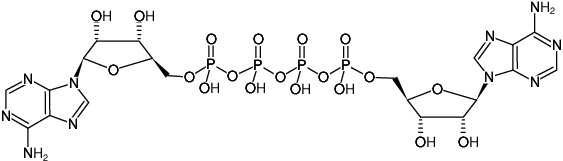
(AppppA)
P1-(5'-Adenosyl) P4-(5'-adenosyl) tetraphosphate, Sodium salt
| Cat. No. | Amount | Price (EUR) | Buy / Note |
|---|---|---|---|
| NU-507-5 | 5 mg | 134,30 | Add to Basket/Quote Add to Notepad |
| NU-507-25 | 25 mg | 537,40 | Add to Basket/Quote Add to Notepad |
For general laboratory use.
Shipping: shipped on gel packs
Storage Conditions: store at -20 °C
Short term exposure (up to 1 week cumulative) to ambient temperature possible.
Shelf Life: 12 months after date of delivery
Molecular Formula: C20H28N10O19P4 (free acid)
Molecular Weight: 836.39 g/mol (free acid)
Exact Mass: 836.05 g/mol (free acid)
CAS#: 5542-28-9
Purity: ≥ 95 % (HPLC)
Form: solid
Color: white to off-white
Spectroscopic Properties: λmax 259 nm, ε 27.0 L mmol-1 cm-1 (Tris-HCl pH 7.5)
Specific Ligands:
Ligand for P2Y receptors:
Agonist at P2Y1 receptor[1], at P2Y2 receptor[2,3], P2Y11 receptors[3,4] and P2Y receptors in brain and lung membranes[5]
BIOZ Product Citations:
Selected References:
[1] Yegutkin et al. (1998) Steady-state binding of[3H]ATP to rat liver plasma membranes and competition by various purinergic agonists and antagonists. Biochim. Biophys. Acta 1373 (1):227.
[2] Lazarowski et al. (1995) Pharmacological selectivity of cloned human P2U-purinoreceptor: potent activation by diadenosine tetraphosphate. Br. J. Pharmacol. 116 (1):1619.
[3] Patel et al. (2001) Activity of diadenosine polyphosphates at P2Y receptors stably expressed in 1321N1 cells. Eur. J. Pharmacol. 430 (2):203.
[4] Communi et al. (1999) Pharmacological characterization of the human P2Y11 receptor. Br. J. Pharmacol. 128 (6):1199.
[5] Reiser et al. (1999) Nucleotide radiolabels as tools for studying P2Y receptors in membranes from brain and lung tissue.Prog. Brain Res. 129:45.
Safrany et al. (2007) Characterisation of a bis (5'-nucleosyl)-tetraphosphatase (asymmetrical) from Drosophila melanogaster. Int. J. Biochem. Cell Biol. 39 (5):943.
Gross et al. (2006) Nucleotide-binding domains of Cystic Fibrosis Transmembrane Conductance Regulator, an ABC Transporter, Catalyze Adenylate Kinase Activity but not ATP Hydrolysis. J. Biol. Chem. 281 (7):4058.
Leslie et al. (2002) Cloning and characterisation of hAps1 and hAps2, human diadenosine polyphosphate-metabolising Nudix hydrolases. BMC Biochemistry 3:20.
Campbell et al. (1999) Characterization of P1,P4-diadenosine 5'-tetraphosphate binding on bovine aortic endothelial cells. Arch. Biochem. Biophys. 364:280.
Vartanian et al. (1999) Ap4A induces apoptosis in human cultured cells. FEBS Lett. 456:175.
Brevet et al. (1985) Variation of Ap4A and other dinucleoside polyphosphates in stressed Drosophila cells. J. Biol. Chem. 260:15566.
Guedon et al. (1985) Effect of diadenosine tetraphosphate microinjection on heat shock protein synthesis in Xenopus laevis oocytes. EMBO J. 4:3743.
Guranowski et al. (1985) Phosphorolytic cleavage of diadenosine 5',5'''-P1,P4-tetraphosphate. Properties of homogeneous diadenosine 5',5'''-P1,P4-tetraphosphate alpha, beta-phosphorylase from Saccharomyces cerevisiae. J. Biol. Chem. 260:3542.
Bochner et al. (1984) AppppA and related adenylylated nucleotides are synthesized as a consequence of oxidation stress. Cell 37 (1):225.
Guranowski et al. (1983) Catabolism of diadenosine 5',5'-P1,P4-tetraphosphate in procaryotes. Purification and properties of diadenosine 5',5'-P1,P4-tetraphosphate (symmetrical) pyrophosphohydrolase from Escherichia coli K12. J. Biol. Chem. 258:14784.
Jakubowski et al. (1983) Enzymes hydrolyzing ApppA and/or AppppA in higher plants. Purification and some properties of diadenosine triphosphatase, diadenosine tetraphosphatase, and phosphodiesterase from yellow lupin (Lupinus luteus) seeds. J. Biol. Chem. 258:9982.

 Powered by Bioz