

Aminoallyl-dUTP-Cy3

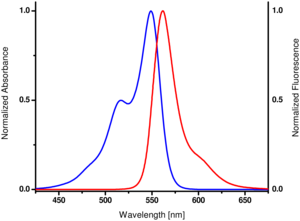
Excitation and Emission spectrum of Cy3
For research use only.
Please centrifuge briefly before opening (volume ≤2 ml).
Description:
Aminoallyl-dUTP-Cy3 is recommended for direct enzymatic labeling of DNA/cDNA e.g. by PCR and Nick Translation. It is incorporated as substitute for its natural counterpart dTTP. The resulting Dye-labeled DNA/cDNA probes are ideally suited for fluorescence hybridization applications such as FISH or microarray-based gene expression profiling. Optimal substrate properties and thus labeling efficiency is ensured by an optimized linker attached to the C5 position of uridine.
Recommended Aminoallyl-dUTP-Cy3/dTTP ratio for PCR and Nick Translation: 30-50% Aminoallyl-dUTP-Cy3/ 50% dTTP
Please note: Protect the Dye-labeled dUTP from exposure to light and carry out experimental procedures in low light conditions. The optimal final concentration of the Dye-labeled dUTP may very depending on the application and assay conditions. For optimal produdct yields and high incorporation rates an individual optimization of the Dye-labeled-dUTP/dTTP ratio is recommended.
Shipping: shipped on gel packs
Storage Conditions: store at -20 °C
Short term exposure (up to 1 week cumulative) to ambient temperature possible.
Shelf Life: 12 months after date of delivery
Molecular Formula: C43H56N5O21P3S2 (free acid)
Molecular Weight: 1135.97 g/mol (free acid)
Exact Mass: 1135.21 g/mol (free acid)
Purity: ≥ 95 % (HPLC)
Form: solution in 10 mM Tris-HCl
Color: pink
Concentration: 1.0 mM - 1.1 mM
pH: 7.5 ±0.5
Spectroscopic Properties: λexc 550 nm, λem 570 nm, ε 150.0 L mmol-1 cm-1 (Tris-HCl pH 7.5), CF260 0.08
Applications:
Incorporation into DNA/cDNA by
- Primer Extension with Klenow fragment[1]
- PCR with Taq polymerase in-house data
- Nick Translation with DNAse I/ DNA Polymerase I in-house data
Selected References:
[1] Walsh et al. (2017) Measurement of incorporation kinetics of non-fluorescent native nucleotides by DNA polymerases using fluorescence microscopy. Nucleic Acids Res. 45 (21):e175.
| Cat. No. | Amount | Price |
|---|---|---|
| NU-803-CY3-S | 10 μl (1 mM) | 104,30 € |
| NU-803-CY3-L | 5 x 10 μl (1 mM) | 403,70 € |
At this point, external content from bioz.com is embedded. When it loads, data (e.g. your IP address) is transmitted to the provider.
Scientific citations for Jena Bioscience nu-803-cy3
39 scientific citations and 9 citation images found by Bioz.
-
RNA Promotes Synapsin Condensates That Organize Synaptic Vesicles in Live Neurons and Enable Localized Translation in Reconstituted System
Advanced Science, 2026-08-21 · PMID:42627687
.. transcription was carried out according to manufacturer's instructions (NEB, E2040S), with the following modifications.. Reactions included 1 μg of DNA template and were supplemented with approximately 0.4 μl of
Cy3 or Cy5‐labelled UTP (Jena Bioscience , NU‐803‐CY5‐S, NU‐803‐CY3‐S).. Following incubation at 37°C for 4 h, the reaction was halted with the addition .. -
The extraordinary satellitome diversity of freshwater crayfish: a driver of genome evolution.
Mobile DNA, 2026-04-30 · PMID:42050625
Plasmid vectors containing the satDNA monomer sequence were labelled with
Aminoallyl-dUTP-Cy3 (Jena Bioscience GmbH , Jena, Germany) using the Nick Translation Reagent Kit (Abbott Molecular Inc., USA) according to the manufacturer’s protocol with the following modifications: plasmid DNA (700 ng) was labelled in a reaction volume of 25 μL using 2.5 μL of enzyme mixture for 6 h at 15 °C. -
Tribolium madens satellitome reveals a network of highly abundant satellite DNAs in megabase-sized regions hallmarked by macro-dyad symmetries
Genome biology, 2026-03-07 · PMID:41795071
.. the sequence variability of satDNA monomers, several clones were usually combined for probe labeling.. SatDNA probes were labeled by PCR using cloned inserts as templates and specific primers, incorporating biotin-16-(5-aminoallyl)-dUTP (Jena Bioscience, Germany) or
aminoallyl-dUTP-Cy3 (Jena Bioscience ).. The labeled dUTP and regular dTTP were mixed in a 1:2 ratio in the ..
