

Hot Start Polymerase Ab+

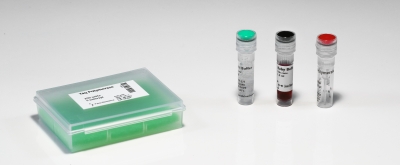
For research use only.
Please centrifuge briefly before opening (volume ≤2 ml).
Description:
Hot Start Polymerase Ab+ provides improved specificity and sensitivity when amplifying low-copy-number targets in complex backgrounds or when prolonged room-temperature set up is required. The polymerase activity is blocked at ambient temperature and switched on automatically at the initial denaturation. The thermal activation prevents the extension of non-specifically annealed primers and primer-dimer formation at low temperatures during PCR setup. The polymerase is recommended for diagnostic applications, high throughput PCR or genotyping.
The enzyme replicates DNA at 72 °C. It catalyzes the polymerization of nucleotides into duplex DNA in 5'→3' direction in the presence of magnesium. It also possesses a 5'→3' polymerization-dependent exonuclease replacement activity but lacks a 3'→5' exonuclease (proof-reading) activity.
Activation step
Hot Start Polymerase Ab+ requires no prolonged heating or denaturing step. The polymerase inhibiting antibody is released within 2 min at 92°C during the initial denaturation step.
Unit Definition: One unit is defined as the amount of the enzyme required to catalyze the incorporation of 10 nmoles of dNTP's into an acid-insoluble form in 30 minutes at 70 °C using hering sperm DNA as substrate.
Shipping: shipped on gel packs
Storage Conditions: store at -20 °C
avoid freeze/thaw cycles
Shelf Life: 12 months
Form: liquid
Concentration: 5 units/μl
Content:
Reaction Buffer and Nucleotides are not included. Please refer to our sections Buffers & Components and Nucleotides.
Hot Start Polymerase Ab+
5 units/μl Hot Start Polymerase Ab+ in 20 mM Tris-HCl, 100 mM KCl, 0.1 mM EDTA, 1 mM DTT, stabilizers, 50 % (v/v) Glycerol, pH 9.0 (25°C)
Preparation of the master mix:
Before starting, thaw up all components and vortex thoroughly to ensure homogeneity.
| component | final assay conc. |
|---|---|
| Reaction Buffer | 1 x |
| dNTP Mix | 200 μM |
| Hot Start Polymerase Ab+ | 0.025-0.05 units/μl |
| primer mix or each primer | 200-400 nM each primer |
| PCR-grade Water | fill up to final volume |
Cycling Conditions:
| initial denaturation | 95 °C | 2 min | 1 x |
|---|---|---|---|
| denaturation annealing 1) elongation 2) | 95 °C 50-68 °C 72 °C | 10-20 sec 10-20 sec 20 sec - 4 min | 25-30 x |
1) The annealing temperature depends on the melting temperature of the primers used.
2) The elongation time depends on the length of the fragments to be amplified. A time of 1 min/kb is recommended.
Recommended Buffer Systems:
qPCR Buffer (#PCR-279) is recommended for use in real-time PCR applications. The buffer contains a well-balanced ratio of potassium-, ammonium- and magnesium-ions to ensure high specificity and minimal by-product formation in probe-based assays as well as in green-dye-based assays. There is no need of additional optimization.,
Crystal Buffer (#PCR-271) is recommended for down-stream applications such as DNA sequencing, ligation, restriction digestion or where an analysis of the PCR product by absorbance or fluorescence excitation is required. For gel electrophoresis add gel loading buffer and fluorescent DNA stain (e.g. Gel Loading Buffer with DNA Stain, #PCR-274 - #PCR-276) before loading the PCR into the gel. Using pre-stained gels or post-run staining protocols is also possible.,
KCl Buffer (#PCR-262) is recommended for use in routine PCR reactions. The buffer is optimized for highest specificity but may require additional fine-tuning of assay parameters like MgCl2 concentration and annealing temperature.,
Ruby Buffer (#PCR-272) includes a density reagent + tracking dye and allows the direct loading of the PCR products into an electrophoresis gel. For DNA detection / fluorescent DNA staining, we recommend to use new generations dyes (e.g. GREEN DNA Stain, #PCR-273) instead of the classical but highly mutagenic ethidium bromide.
Optimization of MgCl2 concentration:
MgCl2 Solution - 25 mM (#PCR-266) is recommended for optimization of the final Mg2+ concentration. A concentration of 1.5-2.0 mM is required for optimal functionality. Lower concentrations give higher specificity, whereas higher concentrations give higher yield.
Related products:
| Cat. No. | Amount | Price |
|---|---|---|
| PCR-423-1KU | 1 kilo unit | 250,20 € |
| PCR-423-10KU | 10 kilo units | 1.251,00 € |
| PCR-423-20KU | 20 kilo units | 2.702,20 € |
| PCR-423-100KU | 100 kilo units | Ask for Quotation |
| PCR-423-1MU | 1 mio unit | Ask for Quotation |
At this point, external content from bioz.com is embedded. When it loads, data (e.g. your IP address) is transmitted to the provider.
Scientific citations for Jena Bioscience pcr-423
6 scientific citations and 0 citation images found by Bioz.
-
Cyclooxygenase-2 activates EGFR–ERK1/2 pathway via PGE2-mediated ADAM-17 signaling in testosterone-induced benign prostatic hyperplasia
Inflammopharmacology, 2022-12-31 · PMID:36586043
.. TRIzol reagent Mini kit (Invitrogen , Carlsbad, CA) in accordance with the manufacturer’s instructions.. The mRNA expression of pro-apoptotic Bax and anti-apoptotic Bcl-2 was detected using a mixture of SYBR Green mastermix and
Hot Start Taq RNA Polymerase (Jena Bioscience , Jena, Germany).. Based on the manufacturer’s guidelines, the following thermo-cycling conditions were applied in standard mode: .. -
Glutathione S-transferases play a role in the detoxification of flumethrin and chlorpyrifos in Haemaphysalis longicornis
Parasites & Vectors, 2018-08-09 · PMID:30092823
.. developmental stage and sex, and their cDNA was synthesized. ... The cDNA was subjected to RT-PCR with a
Hot Start Pol system (Jena Bioscience , Jena, Germany) using GST- specific primers, such as HlGST RT forward and HlGST RT reverse primers, and HlGST2 RT forward and HlGST2 RT reverse primers (Table ), following the manufacturer’s instructions.. The PCR cycle profile was as follows: 94 °C for .. -
The widely distributed hard tick, Haemaphysalis longicornis , can retain canine parvovirus, but not be infected in laboratory condition
The Journal of veterinary medical science, 2014-12-19 · PMID:25650060
The preparation of a PCR mixture and the DNA amplification were performed with the primer set of a forward primer, FeLV_standard_f (5′-CTACCCCAAAATTTAGCCAGCTACT-3′) and a reverse primer, FeLV_standard_r (5′-AAGACCCCCGAACTAGGTCTTC-3′) [ ], which were designed from the unique region of the long terminal repeat (U3-LTR), using
Hot Start DNA Pol (Jena Bioscience , Jena, Germany), following the manufacturer′s recommendation.
