Fluorescence based detection of RNase and DNase activity
| Cat. No. | Amount | Price (EUR) | Buy / Note |
|---|---|---|---|
| PP-409S | 100 reactions | 301,20 | Add to Basket/Quote Add to Notepad |
| PP-409L | 500 reactions | 1.204,60 | Add to Basket/Quote Add to Notepad |
For general laboratory use.
Shipping: shipped on gel packs
Storage Conditions: store at -20 °C
store dark, avoid freeze/thaw cycles
stable at 4 °C for up to 4 weeks
Shelf Life: 12 months
Form: liquid
Description:
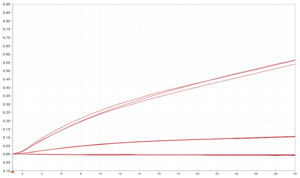
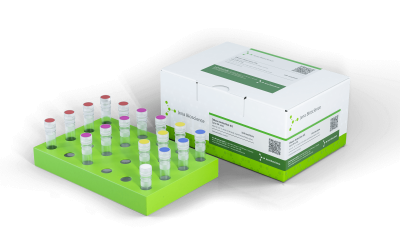
RNase+DNase Detection Kit provides a highly sensitive, fast and easy-to perform multiplex system for parallel detection of RNase and DNase. The kit allows the detection of lowest amounts of RNase and ss- or ds-DNA degrading DNases. It is the ideal tool for contamination testing ranging from a few samples to routine process monitoring. The detection kit is based on a combination of fluorescently labeled RNA and DNA probes. Both probes exhibit minimal fluorescence but showing a strong increase in fluorescence intensity in the presence of RNases and DNases, respectively. The RNA probe is linked to fluorophore FAM as reporter dye, the DNA probe is linked to JOE allowing excitation and detection with nearly all common real-time PCR cyclers or fluorescence readers.
Detection limit
The detection limit of the assay is
RNase A: < 0.1 pg/μl
DNase I: < 1 x 10⁻⁵ units/μl
ROX reference dye
ROX Reference Dye does not take part in the detection reaction and allows therefore anormalization for non-RNase or -DNase related signal variations. We recommend to add ROX as internal standard if the instrument is compatible with the evaluation of the ROX reference signal.
Spectroscopic data of FAM (RNase Probe)
Excitation maximum: λEx = 495 nm
Emission maximum: λEm = 520 nm
Spectroscopic data of JOE (DNase Probe)
Excitation maximum: λEx = 520 nm
Emission maximum: λEm = 548 nm
Use the filter set for VIC if a filter for JOE is not available.
Spectroscopic data of ROX (internal reference)
Excitation maximum: λEx = 576 nm
Emission maximum: λEm = 601 nm
BIOZ Product Citations:

 Powered by Bioz