

HighFidelity Cy3 PCR Labeling Kit

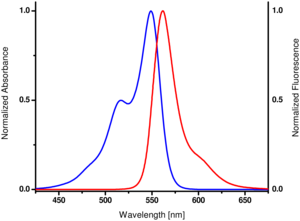
excitation and emission spectrum of Cy3
For research use only.
Description:
HighFidelity Cy3 PCR Labeling Kit is designed to produce randomly Cy3-modified DNA probes by PCR. Such probes are ideally suited for Fluorescence in situ hybridization (FISH) and Northern Blot experiments. PCR-based labeling is superior to random-primed labeling with Klenow fragment if template amounts are limited or amplification of a specific DNA fragments is required. Amplification of probes up to 4kbp is feasible.
dUTP-XX-Cy3 is efficiently incorporated into DNA as substitute for its natural counterpart dTTP using an optimized reaction buffer and a High Fidelity Polymerase blend consisting of Taq polymerase and a proofreading enzyme. 50 % dUTP-XX-Cy3 substitution typically results in an optimal balance between reaction and labeling efficiency. Individual optimization of dUTP-XX-Cy3/dTTP ratio however, can easily be achieved with the single nucleotide format.
The kit contains sufficient reagents for 10 labeling reactions (S-Pack) or 50 labeling reactions (L-Pack) of 20 μl each (50% dUTP-XX-Cy3 substitution, 100 μM dATP/dGTP/dCTP, 50 μM dTTP, 50 μM dUTP-XX-Cy3).
Shipping: shipped on gel packs
Storage Conditions: store at -20 °C
avoid freeze/thaw cycles, store dark
Shelf Life: 12 months
Spectroscopic Properties: λexc 550 nm, λem 570 nm, ε 150.0 L mmol-1 cm-1 (Tris-HCl pH 7.5)
Content:
High Fidelity Polymerase
in storage buffer with 50% glycerol (v/v)
#APP-101-Cy3-S: 1x 40 μl (100 units, 2.5 units/μl)
#APP-101-Cy3-L: 2x 40 μl (2x 100 units, 2.5 units/μl)
High Fidelity Labeling Buffer
1x 500 μl (10x)
dATP - Solution
1x 20 μl (100 mM)
dGTP - Solution
1x 20 μl (100 mM)
dCTP - Solution
1x 20 μl (100 mM)
dTTP - Solution
1x 20 μl (100 mM)
dUTP-XX-Cy3
#APP-101-Cy3-S: 1x 10 μl (1 mM)
#APP-101-Cy3-L: 5x 10 μl (1 mM)
Lambda DNA
1x 20 μl (100 ng/μl)
500 bp forward primer
1x 20 μl (10 μM)
500 bp reverse primer
1x 20 μl (10 μM)
PCR-grade water
1x 1.2 ml
To be provided by user
DNA template
Primer
DNA purification tools (optional)
1. Preparation of working solutions
1.1 Preparation of 1 mM dATP/dCTP/dGTP working solution
- Thaw 100 mM dATP, 100 mM dCTP and 100 mM dGTP solutions on ice, voretex and spin-down briefly.
- Prepare a 1:100 dilution with PCR-grade water to achieve a final concentration of 1 mM (e.g. 2 μl 100 mM dATP + 2 μl 100 mM dCTP + 2 μl 100 mM dGTP + 194 μl PCR-grade water).
- 1 mM ATP/CTP/GTP working solution can be stored at -20°C. Prepare aliquots to avoid freeze/thaw cycles.
1.2 Preparation of 1 mM dTTP working solution
- Thaw 100 mM dTTP solution on ice, voretex and spin-down briefly.
- Prepare a 1:100 dilution with PCR-grade water to achieve a final concentration of 1 mM (e.g. 2 μl 100 mM dTTP + 198 μl PCR-grade water).
- 1 mM dTTP working solution can be stored at -20 °C. Prepare aliquots to avoid freeze/thaw cycles.
3. Standard PCR Labeling protocol
The standard protocol is set-up for labeling of a 500 bp DNA fragment. An optimal balance between reaction and labeling efficiency is typically achieved with 50% dUTP-XX-Cy3 substitution following the standard protocol below however, individual optimization might improve results for individual applications.
- Assemble the PCR on ice in the order stated below (DNAse-free reaction tube).
- Voretex and spin-down briefly.
- Perform assay set-up and reaction under low-light conditions.
| Component | Volume | Final concenctration |
|---|---|---|
| PCR-grade water | X μl | |
| High Fidelity Labeling Buffer (10x) | 2 μl | 1x |
| 1 mM dATP/dCTP/ dGTP working solution (s. 1.1) | 2 μl | 100 μM |
| 1 mM dTTP working solution (s. 1.2) | 1 μl | 50 μM |
| 1 mM dUTP-XX-Cy3 | 1 μl | 50 μM |
| forward primer (10 μM) | X μl | 0.1 - 1 μM (e.g. 0.3 μM 500 bp forward primer) |
| reverse primer (10 μM) | X μl | 0.1 - 1 μM (e.g. 0.3 μM 500 bp reverse primer) |
| template DNA | X μl | 1 - 10 ng genomic DNA (e.g. 1 ng Lambda DNA) |
| High Fidelity Polymerase (2.5 units/μl) | 1 μl | 2.5 units |
| Total volume | 20 μl |
Recommended cycling conditions
| Cycle step | Temperature | Time | Cycles |
| Initial denaturation | 95°C | 2 min | 1x |
| Denaturation Annealing1) Elongation2) | 95°C 58°C 68°C | 20 sec 30 sec 60 sec | 30x |
| Final Elongation | 68°C | 2 min | 1x |
1)The annealing temperature depends on the melting temperature of primers used.
2)The elongation time depends on the length of fragments to be amplified. A time of 2 min/kbp is recommended. Elongation at 72°C works as well.
For optimal amplification results and high incorporation rates an individual optimization of the recommended PCR assay and cycling conditions may be necessary for each new primer-template pair.
4. Probe purification:
Probe purification is not required for most hybridization experiments. If a downstream application requires purification (e.g. concentration determination by absorbance measurement) we recommend silica-membrane or gel filtration-based purification.
Related products: Aminoallyl-dUTP-XX-Cy3, #NU-803-XX-Cy3
| Cat. No. | Amount | Price |
|---|---|---|
| APP-101-CY3-S | 10 reactions x 20 μl | 145,00 € |
| APP-101-CY3-L | 50 reactions x 20 μl | 397,00 € |
At this point, external content from bioz.com is embedded. When it loads, data (e.g. your IP address) is transmitted to the provider.
Scientific citations for Jena Bioscience app-101-cy3
3 scientific citations and 2 citation images found by Bioz.
-
AC electro-osmosis in bacterial biofilms: a cautionary tale for electrophysiology experiments
bioRxiv, 2025-01-24 · DOI:
PrePrint: DNA was obtained from a Lambda DNA product in a
“HighFidelity Cy3 PCR Labeling Kit” (Jena Bioscience ).. It was then purified using a “PCR Purification Kit” (MinElute) and the final product .. -
Active HHV-6 Infection of Cerebellar Purkinje Cells in Mood Disorders.
Frontiers in Microbiology, 2018-06-06 · PMID:30186267
.. Tween 20 and 0.5X SSC/0.1% Tween 20 at 65◦C, then mounted using DAPI/Antifade solution.. Cy3-tagged PCR products were generated from HHV6A (U1102) infected cellular DNA using
Cy3 PCR Labeling Kit (Jena Biosciences , Germany) using the following primer pairs.. U22_For 5′-GGATCCAAAGCAAACCAGCAAGA-3′, U22_Rev 5′-TGGCGGATGGCTAGTGTGCC-3′, U42_For 5′-AGTTAGTTTCACAGGTGTCAGC-3′, and U42_Rev 5′- ACCGAAATCTTTCTTTTACTTGTC-3′.U22_For 5′-GGATCCAAAGCAAACCAGCAAGA-3′, U22_Rev 5′-TGGCGGATGGCTAGTGTGCC-3′, U42_For .. -
Evolutionary dynamics of two satellite DNA families in rock lizards of the genus Iberolacerta (Squamata, Lacertidae): different histories but common traits.
Chromosome research : an international journal on the molecular, supramolecular and evolutionary aspects of chromosome biology, 2016-09-09 · PMID:26384818
Abstract: Satellite DNAs compose a large portion of all higher eukaryotic genomes. The turnover of these highly repetitive sequences is an important element in genome organization and evolution. However, information about the structure and dynamics of reptilian satellite DNA is still scarce
