

Atto550 NT Labeling Kit

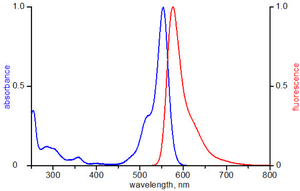
excitation and emission spectrum of ATTO 550
For research use only.
Description:
Atto550 Nick Translation Labeling Kit contains all reagents (except template and materials for purification of the probe) required for nick translation labeling providing a highly efficient, easy-to-perform and rapid labeling technology.
The kit is recommended for direct enzymatic labeling of DNA. The Atto550 NT labeling mix contains specially optimized Atto550-dUTP for incorporation into DNA by nick translation using DNA Polymerase I. The excellent stability and quantum yield of the fluorophore combined with a high incorporation rate of the dye-dUTP complex makes it the ideal choice for a broad range of fluorescence applications.
Nick translation labeling is based on the reverse activities of Polymerase I and DNase I. DNase I is able to introduce randomly distributed nicks to double stranded DNA at low enzyme concentrations. The 5'→3' exonuclease activitiy of Polymerase I removes nucleotides from the 3' side of the nick while synthesizing a partial new complementary strand using the 3'-OH termini as primer. In presence of dye-labeled dUTP Polymerase I incorporates labeled dUTP instead of dTTP. The well balanced polymerase / nuclease activities of the enzyme mix ensure the generation of highly labeled double stranded DNA fragments.
The resultant DNA is suited for application in FISH, microarray gene expression profiling and other nucleic acid hybridization assays.
Protect fluorescent labeled dUTP from light and carry out experimental procedures in low light conditions.
Shipping: shipped on gel packs
Storage Conditions: store at -20 °C
avoid freeze/thaw cycles, store dark
Shelf Life: 12 months
Spectroscopic Properties: λexc 554 nm, λem 576 nm, ε 120.0 L mmol-1 cm-1 (Tris-HCl pH 7.5)
Content:
Enzyme mix (red cap)
2 units/μl polymerase I, 0.02 units/μl Dnase I in storage buffer
NT labeling buffer (green cap)
10x conc.
Atto550 NT labeling mix (purple cap)
0.5 mM dATP, 0.5 mM dCTP, 0.5 mM dGTP, 0.25 mM dTTP,
0.25 mM Atto550-dUTP, pH 7.5
Stop buffer (yellow cap)
0.5 M EDTA, pH 8.0
PCR-grade water (white cap)
Recommended NT assay:
Sample Material can be supercoiled or linearized plasmid DNA, cosmid or BAC DNA, whole or partial chromosomes or purified PCR products.
Prepare the following reaction mixture in a sterile vial.
20 μl Nick translation labeling assay
| fill up to 20 μl | PCR-grade water | white cap |
|---|---|---|
| 2 μl | 10x NT labeling buffer | green cap |
| 2 μl | Atto550 NT labeling mix | purple cap |
| 1-1.5 μg | template DNA | - |
| 2 μl | Enzyme mix | red cap |
- Vortex the mix gently to assure homogeneity and centrifuge briefly to collect the reaction mixture at the bottom of the tube.
- Place the tube in a precooled thermomixer at 15 °C. An incubation of 90 min is recommended to generate DNA fragments in a size range between 200 and 500 bp.
- To control the length of the fragments load 2 μl of the assay on an agarose gel. Place the reaction tube at -20 °C while running the gel.
- To get smaller fragments add additional 2 μl of the Enzyme mix and extend the incubation at 15 °C.
- For final stopping the reaction add 5 μl of Stop buffer (yellow cap). Proceed to purification or store at -20 °C.
Purification of the probe:
To remove unincorporated nucleotides from the reaction mixture prior to its use in subsequent experiments one of the following procedures is recommended:
1. Purification by silica-gel membrane adsorption - PCR Purification Kit, Cat.-No. PP-201
The Jena Bioscience PCR Purification Kit provides a simple and efficient way to purify DNA fragments larger than 100 bp. The preparation is based on a silica-membrane technology for binding DNA in high-salt and elution in low-salt buffer. Please refer to the instruction manual.
2. Purification by Isopropanol precipitation
Add 1 μl glycogene (2 mg/ml), 2 μl sodium acetate (3 M) and 14 μl isopropanol to the reaction mixture and mix well but gently. Incubate on RT for 15 min and spin down at maximum speed at 4 °C for 30 min. Discard the supernatant and wash 2x with 70 % ethanol (spin down at maximum speed for 5 min).
3. Purification by Centrifugal Filter Units
Unincorporated nucleotides can be removed by centrifugation using centrifugal filter units. Select the filter unit by its cut-off for DNA fragments and follow the manufacturer's instructions.
Incorporation rate of the fluorophore:
The efficiency of DNA labeling can be estimated by calculating the ratio of incorporated fluorophores to the number of bases in the fragment (dye / base).
1. Measurement of the optical density: Measure the absorbance of the labeled DNA fragment at 260 nm (A260) and at the excitation maximum (λexc) for the dye (Adye).
2. Correction of the A260 reading: To obtain an accurate absorbance measurement for the nucleic acid, the contribution of the dye at 260 nm has to be corrected. Use the following equation:
Abase = A260 - (Adye x CF260)
Correction Factor for Atto550: CF260 = 0.24
3. Calculation of the labeling rate: The dye to base ratio is given by:
dye / base = (Adye x εbase) / (Abase x εdye)
Extinction coefficients:
Atto550: εdye = 120,000 cm-1 M-1
dsDNA: εbase = 6,600 cm-1 M-1
ssDNA: εbase = 8,900 cm-1 M-1
oligonucleotide: εbase = 10,000 cm-1 M-1
Example: A dye to base ratio of 0.05 corresponds to an incorporation of 10 dye-dUTP nucleotides into a DNA fragment containing 200 nucleotides or, respectively, into a 100 bp PCR fragment. If an equal distribution of dATP, dCTP, dGTP and dTTP in the DNA fragment can be assumed, 10 of the 50 existing dTTPs have been substituted by dye-dUTP resulting in a labeling rate of 20 %.
Related products: Aminoallyl-dUTP-ATTO-550, #NU-803-550
Selected References:
Spangenberg et al. (2020) Cytogenetic mechanisms of unisexuality in rock lizards. Scientific Reports 10:8697.
| Cat. No. | Amount | Price |
|---|---|---|
| PP-305S-550 | 10 reactions | 175,80 € |
| PP-305L-550 | 50 reactions | 557,70 € |
At this point, external content from bioz.com is embedded. When it loads, data (e.g. your IP address) is transmitted to the provider.
Scientific citations for Jena Bioscience pp-305-550
79 scientific citations and 8 citation images found by Bioz.
-
Characterization of Chromosomal Structural Polymorphism in Roegneria nutans from the Western Sichuan Plateau, China Based on Tandem Repeat Sequences.
Plants, 2026-09-26 · PMID:42796862
Genomic DNA of Pseudoroegneria libanotica (2n = 2x = 14, StSt) was extracted using a Plant Genomic DNA Rapid Extraction Kit (Sangon Biotech Co., Ltd., Shanghai, China) and https://doi.org/10.3390/plants15182832 labeled with the
Atto 550 NT (red) DNA Labeling Kit (Jena Bioscience , Jena, Germany).. Oligonucleotide probes used for FISH were synthesized by Sangon Biotech .. -
The role of satellite DNAs in repeatome organization and sex chromosome evolution in the owl monkey Aotus infulatus and congeneric species
Biology direct, 2026-08-27 · PMID:42661224
Seven AinSats were fluorescently labeled using a
nick-translation kit (Jena Bioscience , Jena, Germany) with Atto550-dUTP and Atto488-dUTP fluorophores, following the manufacturer’s manual.. These probes, along with the Cy3-labeled AinSat4-34 and AinSat06-34, were used for Fluorescence in .. -
Programmed chromosome elimination correlates with the overexpression of cohesin and additional B chromosome-encoded genes in Aegilops speltoides
bioRxiv, 2026-07-23 · DOI:10.64898/2026.07.20.739560
PrePrint: .. acetic acid, flash-frozen in liquid nitrogen, and stored in 99.8% ethanol at −20 °C.. For FISH, probes were generated from plasmid DNA encoding the B-specific repeat AesTR-183 and the A chromosome pericentromeric repeat pBs301 , labeled with dUTP-ATTO-488 or dUTP-ATTO-550 by nick-translation (
ATTO NT Labeling Kit ;Jena Bioscience , Germany).. Chromosomal DNA was denatured in 2 N NaOH in 70% ethanol (6 mg/ml) for ..
