
Need a quotation? Create it here!
No login/account required.
No login/account required.
Your Basket/Online Quote
Items: 0 (0,00 €)
» Search & Order
» Sign in / Register
Your Basket/Online Quote
Items: 0 (0,00 €)
» Search & Order
» Sign in / Register
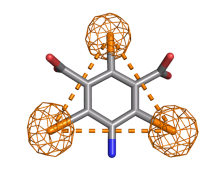
JBS Magic Triangle is a phasing kit developed in co-operation with Tobias Beck in the research group of Prof. George M. Sheldrick, Georg-August University Göttingen.
The “Magic Triangle” I3C consists of three iodine atoms forming an equilateral triangle with a side length of 6.0 Å that can readily be identified in the electron density map.
It has been demonstrated for heavy-atom derivatization of macromolecules, and experimental phases have been derived using single-wavelength anomalous dispersion (SAD) or single isomorphous replacement plus anomalous scattering (SIRAS) methods.